

A kitchen faucet supports food preparation, rinsing, cleaning, and filling cookware every day. A poor choice may fit the sink yet still cause splashing, limit movement, or feel awkward to use.
The selection process should begin with compatibility and then consider workflow, construction, performance, and appearance.
Start With Your Sink and Installation Requirements
Before comparing finishes or spray functions, confirm how the fixture will connect to the sink and fit the surrounding space.
Check the Mounting Type and Number of Sink Holes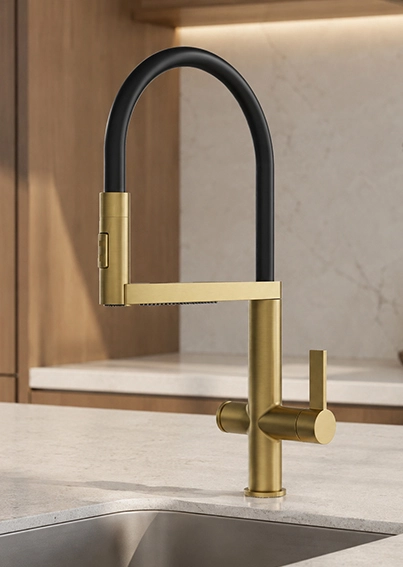
Most kitchen faucets are deck mounted on the sink or countertop. Wall-mounted models require plumbing inside the wall and accurate positioning, so they suit planned construction or major renovation.
Count the mounting holes. An integrated single-handle mixer often needs one hole. Separate handles, side sprayers, and soap dispensers may need more. A deck plate can cover unused openings.
For a replacement, verify:
1.Existing hole number and spacing
2.Sink deck or countertop thickness
3.Clearance for mounting hardware
4.Supply connection size
Compare every measurement with the product drawing before ordering.
Match the Spout Height and Reach to Your Sink
Spout height determines space for pots, while reach determines where the stream lands. Water should fall near the main working area, not hit the back wall or front edge.
A high-arc faucet provides clearance for cookware but may splash in a shallow sink. A lower outlet controls splash better. Check nearby windows, shelves, and cabinets.
Mini case study: A compact apartment has a shallow sink below an inward-opening window. A tall faucet would block the window and increase splash. A lower-profile swivel mixer with suitable reach provides better access.
Choose the Kitchen Faucet Type That Fits Your Workflow
The best configuration depends on how the sink is used, not simply on which design looks current.
Single-Handle vs Double-Handle Kitchen Faucets
A single-handle kitchen faucet controls flow and temperature with a single lever. It is convenient when one hand is holding cookware, and its compact layout simplifies cleaning.
A double-handle model uses separate hot and cold controls. It offers traditional symmetry but usually requires more movement and mounting space.
| Factor | Single handle | Double handle |
| Operation | Quick one handed control | Separate hot and cold control |
| Cleaning | Fewer exterior parts | More areas around handles |
| Installation | Often suits one hole | Usually needs more holes |
| Best fit | Busy modern kitchens | Traditional designs |
Pull-Down vs Pull-Out Kitchen Faucets
A pull-down spray head moves into the sink from a high-arc spout. It suits deep basins, large cookware, and vertical rinsing. Reliable hose retraction and secure docking are important.
A pull-out spray head extends toward the user from a lower-profile spout. It can suit shallow sinks, compact kitchens, and filling containers beside the basin. Compare hose length, spray switching, and under-sink space.
Choose pull-down for generous sink space and downward rinsing. Choose pull-out when lower height and horizontal reach matter more.
High-Arc, Low-Arc and Swivel Faucet Options
High arc describes spout shape and height, while pull-down describes a removable spray function. A faucet can have a high arc without a detachable head.
Low arc models suit limited overhead clearance and may reduce splash in shallow bowls. Swivel movement is useful for double bowl sinks. Check the stated rotation and make sure the spout reaches both bowls without hitting a wall or backsplash.
Evaluate Materials and Performance for Long-Term Use
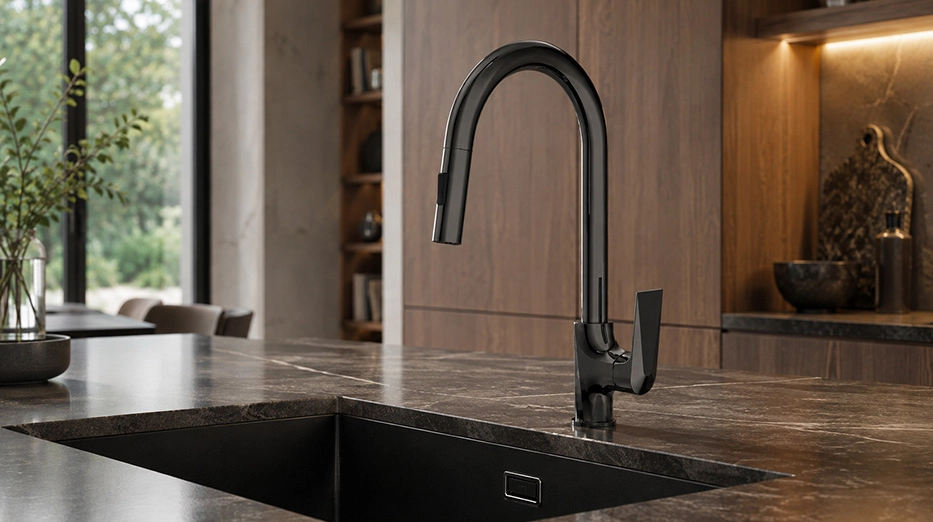
The body, cartridge, aerator, hoses, and connections determine how the fixture performs after repeated daily use.
Compare Solid Brass Construction With Lower-Cost Alternatives
Body material is not the same as surface color. A brass colored finish does not prove that the underlying body is solid brass. Specifications should identify materials used for the body, spout, handle, and major parts.
Solid brass is valued for strength and corrosion resistance. Other constructions may reduce cost or weight, but suitability depends on material grade and engineering.
At EMPOLO, we offer kitchen mixer models made from brass, including single-lever designs with Sedal or ceramic cartridges. Specifications vary by series, so we recommend checking the technical sheet rather than judging construction by appearance.
Inspect the Cartridge, Aerator, Hose and Internal Components
The cartridge controls flow and temperature. A quality ceramic or branded cartridge should move smoothly, close cleanly, and provide stable adjustment.
The aerator shapes the stream, helps control splash, and can support efficient water use. A removable aerator is easier to clean when mineral deposits accumulate. For pull-out or pull-down designs, inspect hose flexibility, connections, retraction, and spray head docking.
Check whether cartridges, aerators, hoses, and mounting parts are replaceable. Compatible parts can extend service life without replacing the complete fixture.
Check Water Efficiency, Certifications and Supplier Support
Flow must balance efficiency with practical rinsing. Excessive flow wastes water and may increase splash, while insufficient flow slows kitchen tasks. Review rated flow together with stated test pressure.
Certifications should match the destination market and project requirements. Technical drawings, installation instructions, warranty terms, and spare part support also matter.
At EMPOLO, we conduct pressure and leakage testing across our products and support applicable certifications including cUPC, WaterMark, WELS, SASO, and TIS. We also provide installation guidance, replacement components, and OEM or ODM support. Buyers should confirm which approvals and terms apply to each model and market.
Match the Faucet Finish and Style to Your Kitchen
After confirming compatibility and performance, use finish and form to create a coherent result.
Choose a Finish Based on Appearance and Maintenance
Chrome is bright and versatile. Brushed finishes can disguise fingerprints and water marks better than polished surfaces. Matte black creates contrast, while brushed gold and gunmetal add warmth or depth.
Use nonabrasive cleaners suitable for the finish. For larger projects, request a sample because lighting can change how the surface looks.
Coordinate the Faucet With the Sink, Hardware and Appliances
Metal surfaces do not need to match exactly. Coordinate undertone, sheen, and design language instead.
Use three checks:
1.Repeat the faucet finish in one nearby detail.
2.Combine warm and cool metals intentionally.
3.Match the silhouette to the room, such as geometric lines for contemporary interiors or softer curves for transitional spaces.
Use a Final Kitchen Faucet Buying Checklist
Verify Every Specification Before You Buy
Before approving a model:
1.Confirm mounting type, hole count, and deck thickness.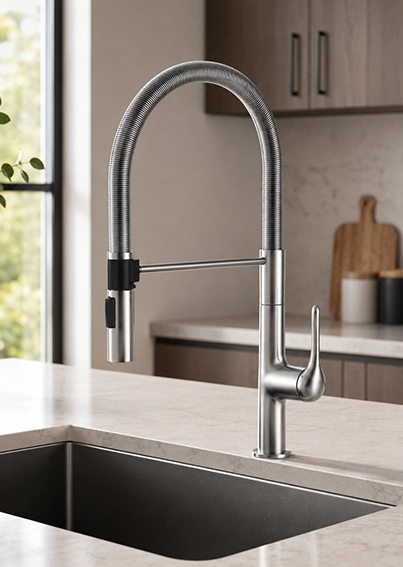
3.Measure spout height, reach, and clearance.
3.Check where the stream will land.
4.Select handle, spray, arc, and swivel functions.
5.Verify the material of major components.
6.Review cartridge, aerator, hose, and docking details.
7.Confirm flow rate and regional certifications.
8.Compare finish appearance and maintenance.
9.Check installation documents, warranty, and spare parts.
10.Confirm plumbing compatibility.
A useful kitchen faucet buying guide leads to a measurable decision. Choose a fixture that fits the sink, supports daily routines, and provides clear construction and service information.
FAQ
Q: How do I choose the right kitchen faucet size for my sink?
A: Measure from the mounting point to the center of the bowl, then check basin depth and overhead clearance. The outlet should direct water into the main sink area without excessive splash.
Q: Is a pull-down or pull-out kitchen faucet better?
A: A pull-down model often suits deep sinks and large cookware. A pull-out design can be better for shallow basins, compact spaces, and tasks requiring more horizontal reach.
Q: How many holes are needed for a kitchen faucet?
A: An integrated single-handle faucet may require one hole. Separate handles, side sprayers, and soap dispensers can require additional holes. Check the sink layout and installation drawing before ordering.