

There are many differences between single-handle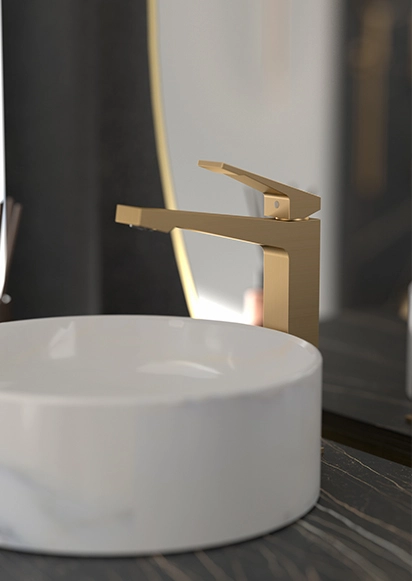 faucets and double-handle faucets that extend far beyond just their looks. The configuration of the faucet handles affects how one uses the faucet on a daily basis, as well as how one can clean under the faucet, install the faucet in the first place, and perform repairs down the line. Single-handle faucets are most often sought after by customers looking for a very clean, simple look that is easy to use. In contrast, two-handle faucets have separate hot and cold handles and are typically considered to be more aesthetically symmetric than their single-handle counterparts.
Whether the better solution is to install a new or a replacement system depends on several factors, i.e., the user, the installation conditions, and whether it is a new build or a replacement.
Single Handle vs. Double Handle Faucets: Quick Comparison
What Is the Main Difference Between Single and Double Handle Faucets?
A single-handle faucet is controlled with a single lever to turn on and off the water and to control the temperature. A double-handle faucet, on the other hand, is controlled with two handles; one handle is for the hot-water supply, and the other is for the cold-water supply.
A one-handle faucet-mixer is very easy to use since you only need to open one handle in order to increase/decrease the mixing ratio. On the other hand, 2-handle faucet-mixers allow for control of each supply separately. One handle for fast, easy, and clean operation. Two handles for individual control and aesthetically balanced mixers. In terms of the quality of the product, the body, the cartridges, the aerator, and the installation all play a part.
Single vs. Double Handle Faucet Comparison Table
| Factor | Single Handle Faucet | Double Handle Faucet |
| Operation | One control for water flow and temperature | Separate controls for hot and cold water |
| Ease of use | Fast and suitable for one-hand operation | Requires adjustment of two handles |
| Temperature control | Flow and temperature are regulated through one cartridge | Hot and cold water are adjusted independently |
| Cleaning | Fewer exposed components and gaps | More surfaces and gaps to clean |
| Typical style | Minimalist and modern | Classic, decorative, or traditional |
| Common layout | Often used in compact or single-hole installations | Often used in widespread or multi-hole installations |
How Single Handle and Double Handle Faucets Work
How a Single Handle Faucet Controls Water Flow and Temperature
The cartridge within a single lever mixer is responsible for mixing the correct proportion of hot and cold water that is then released from the spout. Turning the handle increases or decreases the flow of water and also alters the ratio of hot to cold water. A quality ceramic cartridge will allow smooth operation, ensure a tight shut-off, and offer precise control.
Suitable for use in kitchens, family bathrooms, and smaller washrooms where operation does not require changing from the grip position. Performance will depend greatly on the quality of the cartridge; stiffness or uneven adjustment could indicate wear or poor installation.
How a Double Handle Faucet Mixes Hot and Cold Water
A two-handle faucet has separate hot and cold water valves. When both handles are opened, both supplies go to the faucet’s spout where they mix together and go out as a combined stream. The temperature can then be changed by adjusting one or the other handle.
This type of control is typical of widespread basin mixers with a balanced, traditional appearance. It requires more movements to attain a preferred temperature than a single lever.
Key Differences Between Single Handle and Double Handle Faucets
Ease of Use and Accessibility
Single-handle faucets are generally easy to use because they require less grip strength and fewer actions to complete than two-handle faucets. Also, because of their long lever, they can be operated with the hand, wrist, or even the forearm. This makes them ideal for children, the elderly, and people with less dexterity than average.
Double-handle faucets can be very convenient when turned smoothly, but generally, single knobs and especially small cross handles are not very accessible because they require very specific gripping. When planning for accessibility of faucets, the length of the handle, the amount of force required to turn, the clearance needed, and local regulations are more important than the number of handles.
Temperature Control and Water Efficiency
2 handles for direct control of hot and cold water. Even with only 2 handles, a good single lever handle can be set to a comfortable position in no time and will even return to this position for you.
The number of handles is not the key to water efficiency. Other factors, such as the rated flow, the aerator design, the cartridge, and the supply pressure, are just as important as the actual use of the faucet. While an aerator is used to regulate the stream of water and soften it, flow-control components can help prevent excessive water usage. The water-saving performance of a faucet with a fixed number of handles should not be compared on the basis of a single feature. Instead, customers should compare the verified flow rates for a specific market and usage.
Installation and Mounting Requirements
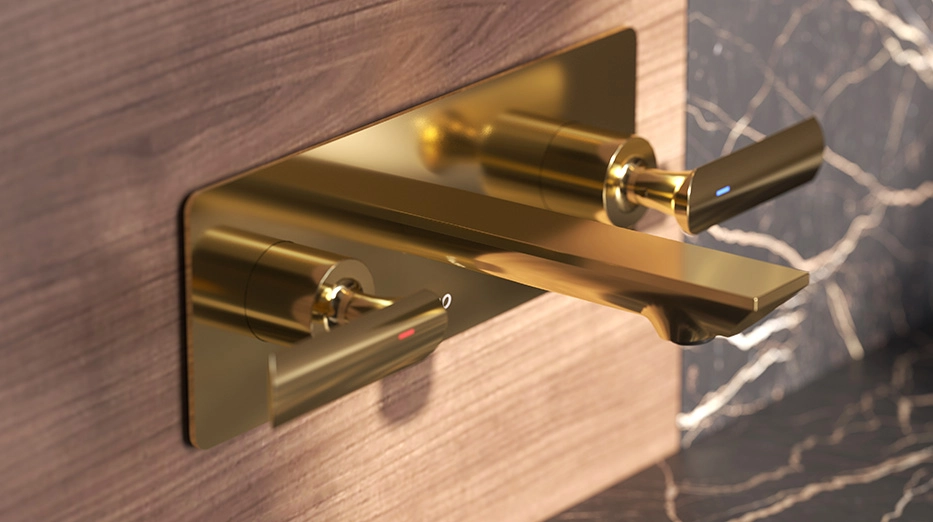
While handle count and mounting-hole count may sound like the same thing to you, many differing configurations use varying numbers of holes to accomplish basically the same thing. Many single-lever basin faucets are designed to be mounted in one hole, while most widespread double-handle models require 3 holes. 2-hole and wall-mounted are offered by EMPOLO.
Before ordering, check:
- The number and spacing of existing holes
- Deck thickness and available clearance
- Hot and cold supply positions
- Hose and mounting-kit compatibility
- Access for installation and servicing
When doing a renovation, keeping the existing layout can save on labor costs as well as avoid having to redo the countertops and plumbing. When doing a new construction project, select the faucet first and then drill the mounting surface for it.
Cleaning, Maintenance, and Long-Term Cost
A single-handle faucet typically has fewer parts exposed to view, which makes it easier to remove water spots and clean off soap scum. Double-handle faucets, on the other hand, have more joints and smaller spaces to clean.
The long-term cost of a handle is far more a function of the construction of the handle, the period of serviceability of the handle, as well as the various parts that are replaceable within the handle. It is therefore very important for someone purchasing a handle to confirm whether or not the various parts and pieces, such as the cartridge, the aerator, the hose, as well as the mounting components, are available for that particular handle. On a multi-unit type of project, it is also very advantageous to have handles that have standardized internal parts, as this can greatly simplify the inventory that a technician will need to stock, as well as enable the technician to be properly trained to service the various handles that are used.
Pros and Cons of Single-Handle and Double-Handle Faucets
Advantages and Disadvantages of Single-Handle Faucets
The advantages of a single-handle mixer are: easy use, small design, easy cleaning, and fast temperature change. It is also very suitable for a minimalistic interior and a small basin.
Share of one mechanism for flow and temperature, so small changes can affect both variables. Service to the central cartridge will affect both functions. Some users will prefer the clear separation of two controls as opposed to an integrated solution.
Advantages and Disadvantages of Double Handle Faucets
Two-handle faucets offer independent control of water, balance in their aesthetic, and the ability to complement classic, luxury, or decorative interiors. Such faucets allow for fine adjustment, as two separate controls are required to make changes to the water.
Adding a second valve body to control a multi-hole configuration adds several disadvantages, including more steps to operate, additional surfaces to clean, and larger space requirements. Multi-hole configurations can also add to the time required for installation. In a high-usage facility, the ability of guests to operate the valves will be important, as will the ability of service personnel to access both valve assemblies without damage to surrounding finishes.
Which Faucet Type Is Better for Your Project?
Choosing for Residential Bathrooms and Kitchens
A single lever is suitable for a family kitchen as it is easily operated with one hand whilst holding cookware, food, etc., with the other hand. In small bathroom areas, the single lever keeps the basin area uncluttered.
A double-handle faucet is typically found in bathrooms that have symmetrical sinks and really traditional decor. But double-handle faucets can also be great for a guest bathroom with lots of counter space.
A simple decision rule is:
- Choose one handle for speed, compactness, and ease of use.
- Two handles for independent control. Formal.
- Use existing holes and plumbing as your guide in selecting fixtures for your renovation.
Choosing Hotels, Commercial Projects, and Renovations
Selection for commercial projects should consider the items of consistent operation, serviceability, finish quality, availability of spares, and market suitability. A single lever is often better for guest operation and for cleaning. A double handle is better for a premium design to suit upmarket developments.
EMPOLO faucet ranges available are a solid brass finish using Sedal or ceramic cartridges, supplied in a multitude of finishes and with replacement parts available. Items are pressure-tested and leak-tested during quality control.
Before releasing a bulk order, procurement should compare samples, check for necessary certifications, check the finish, and review the installation drawings.

FAQ
Q: Which is better, a single-handle or double-handle faucet?
A: A single-handle faucet is best for a quick one-hand turn, for cleaning, and for looks. A double-handle faucet is best for separate hot and cold controls and for a more traditional symmetrical look. Your choice will depend on the user, the plumbing setup, and the look you wish to achieve.
Q: What is the main difference between single-handle and double-handle faucets?
A: A single-handle faucet has one handle and one control for temperature and flow. It contrasts with a double-handle faucet, which has two separate handles for hot and cold. The comparison would cover issues of how you use them, their installation, cleaning, and even the way they look.
Q: Are single-handle faucets easier to use than double-handle faucets?
A: Typically, a single-handle lever requires fewer movements to operate than a double-handle faucet and usually is operated with one hand or forearm. Double-handle faucets are typically adjusted separately, but can be desirable to some users for separate control of hot and cold water.
Q: Do double-handle faucets provide better temperature control?
A: They provide separate adjustment of the hot and cold supplies, which some users find more precise. A well-designed single-lever faucet with a quality cartridge can also deliver smooth and accurate temperature control.
Q: Are single-handle faucets easier to install and maintain?
A: These can be easier to clean and are available in very compact mounting options. However, the installation and service of these would be determined by the number of holes, the plumbing configuration, the type of cartridge used, access to the cartridge, and availability of replacement parts.