

A thermostatic bath shower mixer can deliver a safer and steadier bathing experience. This holds true only when the valve fits the building’s hot-water system, pressure, pipe layout, and required outlets. The valve cannot fix an undersized boiler, weak supply, or poor plumbing. Before choosing a model, compare its technical data against actual operating conditions instead of judging by looks alone.
What Does a Thermostatic Bath Shower Mixer Actually Do?
A thermostatic mixer controls the temperature delivered to a bath spout, hand shower, overhead shower, or another connected outlet. The internal mechanism reacts to variations in the incoming supplies. This reaction helps the mixed water stay close to the selected setting. A thermostatic mixer controls the temperature delivered to a bath spout, hand shower, overhead shower, or another connected outlet. Its internal mechanism responds to changes in the incoming supplies. The mechanism helps the mixed water remain close to the selected setting.
How It Mixes the Supplied Hot and Cold Water
Hot and cold water enter through separate inlets. A temperature-sensitive element reacts when the mixed water becomes hotter or colder than required, and the cartridge changes the proportion of each supply.
The process is automatic but still depends on adequate hot water, sufficient flow, and correctly connected inlets. If either supply falls outside the valve’s permitted range, temperature stability and output may decline.
Why It Does Not Normally Need Electricity
A conventional mechanical thermostatic valve uses the physical response of its internal element, so it normally operates without mains electricity. The boiler or heater supplies hot water; the valve controls mixing.
Digital displays, pumps, smart controls, and electric showers are different. Their power requirements vary, so check the product sheet.
Which Hot Water Systems Are Compatible?
Compatibility depends on the complete system. This table is a starting point; the selected model’s specification remains decisive.
| Hot-water system | Typical suitability | Main checks |
| Combi boiler | Often suitable | Hot-water flow, pressure stability, simultaneous demand |
| Unvented cylinder | Commonly suitable | Pressure, stored capacity, pipe sizing |
| Vented storage system | Model dependent | Static head, dynamic pressure, supply balance |
| Gravity-fed system | Careful selection needed | Low-pressure rating, resistance, possible pump |
| Instantaneous heater | Model dependent | Activation flow, output, temperature rise |
Combi Boilers and Pressurized Water Systems
A combi boiler heats water on demand, so performance depends on how much hot water it can produce at the required temperature rise. A high-flow valve cannot increase boiler output.
Check domestic hot-water flow, the mixer’s operating range, and fixtures that may run simultaneously. Opening a kitchen tap may reduce available flow. The cartridge can compensate for moderate changes, but not for an inadequate supply.
Storage Water Heaters and Unvented Cylinders
Stored systems can work well with thermostatic controls because they provide a reserve of heated water. Tank capacity and recovery rate still matter, especially where baths are filled frequently.
Unvented cylinders usually deliver pressurized water, but pipe diameter, pressure controls, and simultaneous demand affect results. For multi-room projects, calculate peak use.
Gravity-Fed and Low-Pressure Systems
Gravity-fed systems rely on the height between the storage tank and outlet. Long pipe runs, small pipes, bends, filters, and restrictive showerheads can reduce dynamic pressure.
Use a mixer approved for the available conditions. When pressure is too low, the solution may be a dedicated low-pressure valve, improved pipework, or a correctly specified pump. Both hot and cold supplies should remain reasonably balanced.
Water Pressure and Plumbing Requirements
Static pressure is measured when water is not flowing. Dynamic pressure refers to the condition affecting the shower during use, while flow rate describes the volume of water delivered.
Minimum Pressure, Flow Rate and Balanced Supplies
Review three values before purchase:
- The valve’s minimum and maximum operating pressure
- The dynamic flow available at the installation point
- The permitted difference between hot and cold inlet pressures
Acceptable static pressure does not guarantee good flow after pipe losses. Large pressure differences may also reduce temperature stability. Keep both supply routes balanced and avoid unnecessary restrictions.
Hot and Cold Inlet Layout, Filters and Check Valves
Confirm inlet positions before tiling or closing the wall. Reversed supplies can prevent correct operation unless the mixer is designed for them.
Filters protect the cartridge from debris, while check valves help prevent crossflow. Flush new pipework before connection. Concealed installations also need service access because filters, cartridges, and seals may require maintenance.
How to Choose the Right Mixer for Your Project
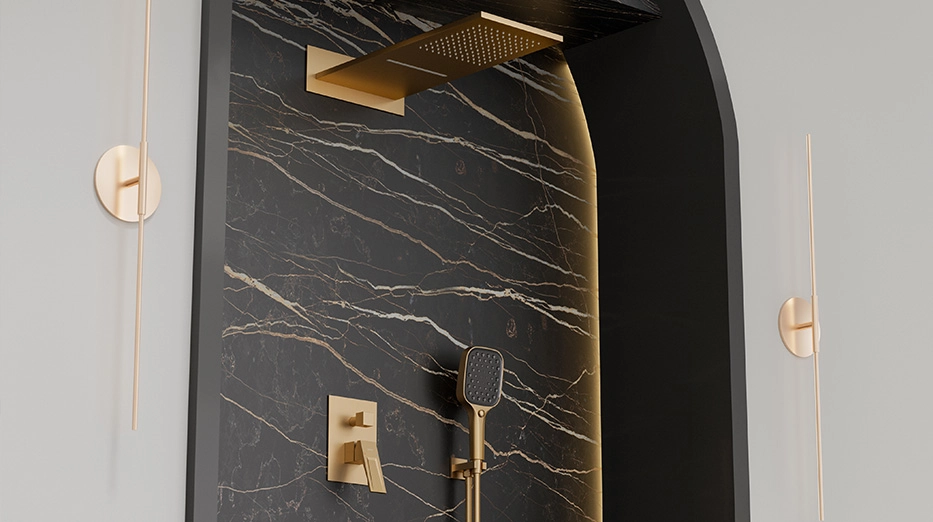
Selection should combine hydraulic requirements with bathroom layout, maintenance access, user needs, and design. A matching finish alone does not make a valve suitable.
Exposed vs Concealed Thermostatic Shower Mixers
An exposed mixer keeps the main body visible and is generally easier to install, inspect, and replace. It can suit renovations where opening the wall is undesirable.
A concealed model places the body and connections behind the finished surface. It creates a cleaner appearance but requires accurate rough-in dimensions, sufficient wall depth, waterproofing, and service access.
| Factor | Exposed mixer | Concealed mixer |
| Installation | Usually simpler | Requires wall preparation |
| Service access | Direct | Depends on access design |
| Appearance | Body remains visible | Minimal, integrated finish |
| Renovation use | Often convenient | Best when walls are open |
Single, Dual and Multiple Outlet Configurations
A single-outlet valve serves one function. Dual and multi-outlet controls may serve an overhead shower, hand shower, bath spout, or body jets through separate controls or a diverter.
Each additional outlet increases the need to confirm available flow. If two functions can operate together, calculate their combined demand.
Mini case: A hotel bathroom includes a rain shower, hand shower, and bath spout. Before approving a three-function concealed control, the team checks cylinder capacity, branch-pipe size, simultaneous-use logic, and panel access. This avoids selecting a sophisticated valve that the water system cannot support.
Cartridge Quality, Body Material and Certifications
The cartridge affects temperature response, flow control, and service life. Buyers should also review body material, seals, spare-part availability, finish durability, and destination-market compliance.
At EMPOLO, we manufacture solid-brass faucets and shower systems through in-house casting, CNC machining, polishing, plating, assembly, and testing. Our range includes concealed thermostatic valves with ceramic cartridges, adjustable-flow push controls, digital temperature displays, and one- to four-function configurations in several finishes. Certification varies by model and market, so required approvals should be confirmed during specification.

Installation and Commissioning Checklist
A compatible valve may still perform poorly if debris enters the cartridge, inlets are reversed, or commissioning is incomplete. Follow the model-specific manual and local plumbing rules.
Checks Before Installation and Testing After Installation
Before installation:
- Verify the hot-water source, dynamic pressure, flow, and inlet temperatures.
- Confirm pipe centers, inlet orientation, wall depth, and outlet connections.
- Flush the pipes and inspect filters, check valves, seals, and fittings.
- Keep concealed components accessible for service.
After installation:
- Check every connection for leakage.
- Run each outlet separately and, where allowed, simultaneously.
- Calibrate the selected temperature.
- Test the temperature limit or safety stop.
- Observe performance while another nearby fixture is opened.
At EMPOLO, we conduct pressure and leakage testing across our products and provide installation manuals and step-by-step video guidance. The installer must still test the completed system because pipework, supply conditions, and fitting quality are project-specific.
FAQ
Q: Does a thermostatic bath shower mixer heat the water?
A: No. It blends hot and cold water supplied by the building. The boiler, cylinder, or heater produces hot water, while the thermostatic mechanism regulates the mixed outlet temperature.
Q: What water pressure does a thermostatic bath shower mixer need?
A: There is no universal requirement. Compare the model’s operating pressure, recommended flow, and permitted hot-to-cold pressure difference with measured site conditions.
Q: Do thermostatic showers need electricity?
A: A standard mechanical mixer normally does not. Digital controls, displays, pumps, electric showers, and smart systems may require batteries or a wired supply, depending on their design.
Q: Can a thermostatic shower mixer work with a low-pressure or gravity-fed system?
A: Yes, when the valve is rated for the available pressure and flow. Some systems may need less restrictive pipework, a low-pressure model, or a properly specified pump.